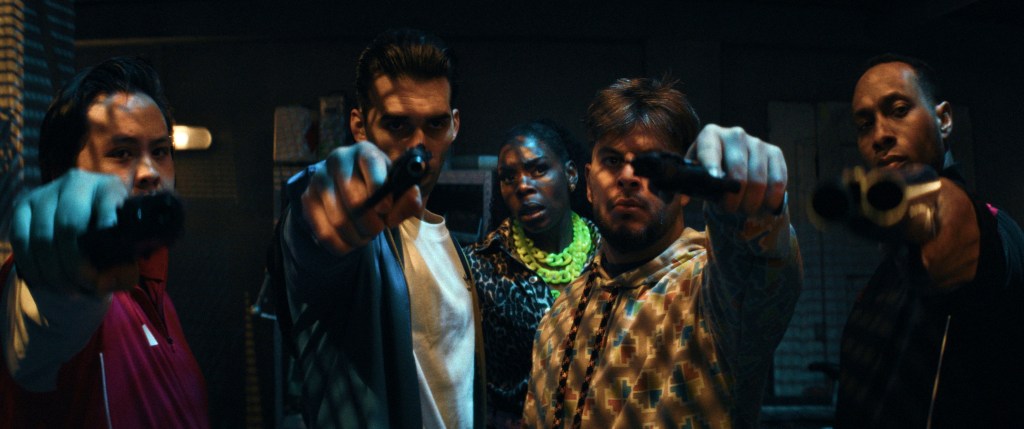
Hope, redemption and authentic representation can often drive a gripping story that reimagines the modern action hero. That’s certainly the case with the development of the protagonist and overall story in the new action thriller, ‘Attack on Paradise.’ The film offers a unique perspective on the genre’s relatable premise, as it follows the reluctant hero who didn’t choose to fight. But at the same time, he isn’t going to back down from one to protect the people he loves
Said Boumazoughe played the protagonist of Suleyman in the drama. He also wrote the script with Sven Huybrechts and Salahdine Ibnou Kacemiere. The movie, which is a co-production between Belgium and The Netherlands, is presented in Dutch and Arabic with English subtitles.
Bob Colaers served as the thriller’s director. Besides Boumazoughe, Achmed Akkabi, Jamal Ben Saddik, Said Clara Cleymans and Imanuelle Grives also star in the film.
‘Attack on Paradise’ follows Suleyman as he’s released from prison following a seven-year sentence. He’s determined to pick up his life again as he reintegrates back into society. His only wish is to return to Antwerp’s Paradise apartment complex and spend time with his ailing mother.
But Paradise no longer lives up to its name. Drug lord Prince Hamza (Akkabi) has taken over the residential community. He takes over the top floor and makes Paradise his personal fortress.
As a result, a police raid of Paradise begins on the day that Suleyman returns home. The sweep places the outmatched and outgunned police against Prince’s private army. The officers are so determined to stop the criminals that they’re willing to accept the deaths of innocent tenants as collateral damage.
Now paired with dissident rookie cop Yasmine (Cleymans), Suleyman only wants to protect his mother and get her out of Paradise before things get worse. However, that’s not going to be easy. Suleyman and Yasmine are now going to take on Prince’s thugs and retake Paradise floor by floor, no matter how deadly the fight becomes.
‘Attack on Paradise’ had its World Premiere on July 19 in the Horizon 2026 section during the Fantasia International Film Festival. In honor of the drama’s premiere at the Montreal-based festival, Colaers and Boumazoughe generously took the time the day after the screening to talk ab out scribing, helming and starring in the feature during an exclusive interview.
Film Factual (FF): Saïd, along with Sven Huybrechts and Salahdine Ibnou Kacemi, you co-wrote the script for the new action thriller, ‘Attack on Paradise.’ What was the inspirating in creating the screenplay, and how did you approach scribing the story?
Bob Colaers (BC): When I got involved, there was already a screenplay because Saïd came with the original idea. Maybe Saïd can tell you more about that.
Saïd Boumazoughe (SB): Yes, exactly. I came up with the idea because we don’t have many stories told by us – for the hood, by the hood. In Belgian cinema, it’s still uncommon to have a diverse main cast.
As an actor, I was getting tired of always being cast as number 25 on the call sheet—the angry guy, the terrorist, the drug dealer. I never saw anyone telling the story of the kids from the neighborhood where I grew up.
I’m from the suburbs of Antwerp, where we shot the film. The apartment building is actually in my neighborhood. I grew up without heroes who looked like me, so I felt it was time to create our own action hero.
I grew up watching Bruce Lee, Jackie Chan, Chuck Norris, Jean-Claude Van Damme and Steven Seagal. But whenever you talked about making those kinds of movies in Belgium, people would say, “You can’t make that kind of film here.”
Fortunately, I met amazing producers who introduced me to an amazing director sitting next to me, Bob Colaers. That’s why I created Paradise. I wanted to create a hero with a heart. We don’t support violence—we support talent, hope, and second chances. That’s what the film is really about.
We also wanted to create a hero for the next generation—someone audiences can identify with. That’s why we made this film.
FF: Speaking about directing, how did you approach working together on set as the helmer and actor?
BC: When I got the screenplay and accepted the job, Saïd and I spent a lot of time together because he had created the story. He already had a very clear vision, and I wanted to understand it inside and out.
We also handled the casting together. We didn’t want to go with the usual types – we wanted to discover new talent. Many of the people we cast came straight from the streets and had never attended acting school.
Once we started shooting, Saïd trusted me to direct the film my way. I blended his vision with mine, and that’s how Paradise came together.
FF: Speaking of casting, Saïd, you play Suleyman in ‘Attack on Paradise.’ Why did you decide to also star in the drama? Achmed Akkabi, Jamal Ben Saddik, Clara Cleymans and Imanuelle Grives also star in the movie. How did you approach casting the supporting character?
SB: One person we definitely have to mention is Sven Habets. I wrote the original script, but then it had to become a workable screenplay. The first draft was around 130 or 140 pages. Together with the co-writer, we shaped it into a script of about 97 or 99 pages.
I had a clear vision, but I trusted Bob with it. Once I handed it over, I let him do his job. At the same time, whenever I had an idea, Bob always respected it. There was mutual respect throughout the entire process.
We also already knew each other from a previous production. It wasn’t like Bob had just read a script and jumped on board—we’d known each other for about ten years. The producers suggested several directors, but as soon as I heard Bob’s name, I said, “No, I want to work with Bob.”
He had made a fantastic low-budget series called Try Zombie, and it was incredibly original. I knew I needed someone who thought outside the box and wasn’t afraid to work in the suburbs or to whitewash the project.
That’s important because this genre has its own language, its own goals, and its own vision. Bob is like a chameleon. Working together became a learning experience for both of us—technically for me, and creatively for him. We shared our worlds with each other, and that’s what made the final result possible.
As Bob said, we shot the film in just 25 days, and we never had a single argument.
BC: What was really nice during the shoot was that everyone involved wanted to make a great action film.
There were moments when the technical crew was setting up a scene, and Saïd, the other actors and I would talk through it together. Sometimes we changed things during filming because we realized there was a better way to do it.
Everyone wanted to give their best to the film. I think that’s one of the reasons it turned out so well.
A good example is the goats. They weren’t in the script, but at some point, we decided to include them in the movie. It was a last-minute decision, and it worked out beautifully.
FF: Speaking of those last-minute decisions, did you do much improvisation on set or make many changes to the script while you were filming?
BC: We didn’t really run into any problems. One funny story is from the very first day of shooting. We filmed the opening scene with the police under the bridge. After watching a take, I thought it looked great, but I wanted to add one small detail while Saïd’s character was running away.
Unfortunately, during that take, Saïd accidentally punched the other actor really hard in the face. But apart from that, everything went smoothly.
SB: The funniest moment for me happened during the prison scenes. Bob even made a cameo, like Quentin Tarantino does in his films. He played one of the prison guards.
At one point, the inmates realized we were filming inside the prison. We hadn’t brought any sound equipment into the cells, but suddenly all the prisoners started banging on the doors and pipes. They were shouting my name and cheering us on.
When we walked out, the entire prison was applauding us. It was an incredible experience.
Of course, we also had bloopers, stunt mishaps and fight scenes that didn’t always go as planned – just like the outtakes you see at the end of Jackie Chan movies. Those little moments are part of filmmaking. They’re memories we’ll always keep because they make the experience feel human.
FF: Speaking about the stunt work and action sequences, how did you collaborate with each other and with the rest of the cast to build those scenes?
SB: It was a great collaboration because we trusted each other.
Bob would explain how he wanted to shoot a scene and what camera angles he wanted, and then I’d adapt my performance accordingly. I didn’t have a stunt double, and many of the other performers were professional stunt artists, so I relied on Bob’s direction. If he wanted me to play a scene a certain way, that’s exactly what I did.
FF: Steven Vanvolsem served as the director of photography on ‘Attack on Paradise.’ How did you all work together to decide how you wanted the drama to look visually?
BC: This kind of film gives you the opportunity to take creative risks.
I like using color in my films, so I thought it would be interesting to give each floor of the building its own color palette and visual style. I was worried that if every fight scene looked the same, the action would become repetitive.
Instead, I wanted each sequence to have its own identity so the audience would constantly be surprised by both the visual style and the action.
FF: You also shot the movie in real locations, including the prison, like you mentioned earlier. How did you decide where to shoot the thriller?
BC: It was an amazing experience because, as far as we know, no one had ever filmed inside a real Belgian prison before. We were the first production to do it.
Since then, Saïd has even received a message from the prison director saying she’d like to screen the movie for the inmates. We’re trying to make that happen. It would be a bit like Johnny Cash performing at Folsom Prison –we’d be bringing our film back to the people who inspired part of it.
SB: That’s really what the film is about. It’s about hope.
We’re not trying to glorify prison. Prison is still a place where people have made mistakes. But it’s also a place where people shouldn’t lose hope.
Earlier we talked about creating a new kind of hero. That’s always been important to me. When Bob read the letter I wrote about growing up without heroes who shared my background. He understood exactly why this story mattered.
BC: While I was filming, I kept reminding myself that we were making this movie for young people who sometimes feel abandoned by society.
We hope they’ll see Sulayman as someone they can look up to, and when they leave the cinema, they’ll believe they should never give up. For both Saïd and me, that’s the most important message in the film: never give up.
Sulayman is also the prophet Solomon in both the Bible and the Quran. According to tradition, he could communicate with animals and spirits. He was a king of both the living and the unseen worlds.
FF: Maxim Lany served as the film’s composer. How did create the music for the drama together?
BC: I wanted to do something different with the music. I felt this type of film could use electronic music – something with a techno influence – but blended with Arabic and urban musical elements. That combination gave the film its own identity.
Our composer had never scored a feature film before, but he gave everything he had to the project.
SB: That’s something I love about this movie. We wanted to give opportunities to people who deserved them.
Just as we cast actors who weren’t the usual choices, we also looked beyond the usual people in the technical departments. The whole production was built by outsiders.
The music reflects that. You hear Arabic, Berber and local rap influences throughout the score. Our composer, Maxim, was primarily known as a DJ, and this was his first opportunity to compose a feature film.
We were also inspired by scores like ‘Mortal Kombat’ and ‘Blade.’ In many ways, the film is an homage to the action movies we grew up watching.
Hollywood gave us ‘Mortal Kombat’ and ‘Blade.’ Now we’re giving ‘Paradise’ back to audiences in America and Canada.
FF: Brian Ent served as ‘Attack on Paradise’s editor. How did you put the final version of the movie together?
BC: It took a long time. We had around 500 visual effects shots, so there was a lot of work to do.
But it was a wonderful journey. I love seeing a project evolve from nothing into a finished film. Watching all the pieces come together is one of the most rewarding parts of filmmaking.
FF: ‘Attack on Paradise’ had its World Premiere (the night before the interview) during the Fantasia International Film Festival. What does it mean to you both to share the thriller with audiences at the festival?
BC: It’s amazing. Fantasia is one of the biggest genre film festivals in the world, so it’s a huge honor to premiere ‘Attack on Paradise’ here.
I was really nervous before the screening because this was actually the first audience to see the finished film. Saïd had seen it, the producers had seen it and of course I had seen it, but none of the other actors or crew members had yet. The Belgian and Dutch premiere won’t happen until (next month in September).
To see the audience respond so positively was incredibly rewarding. That’s exactly why we made this film.