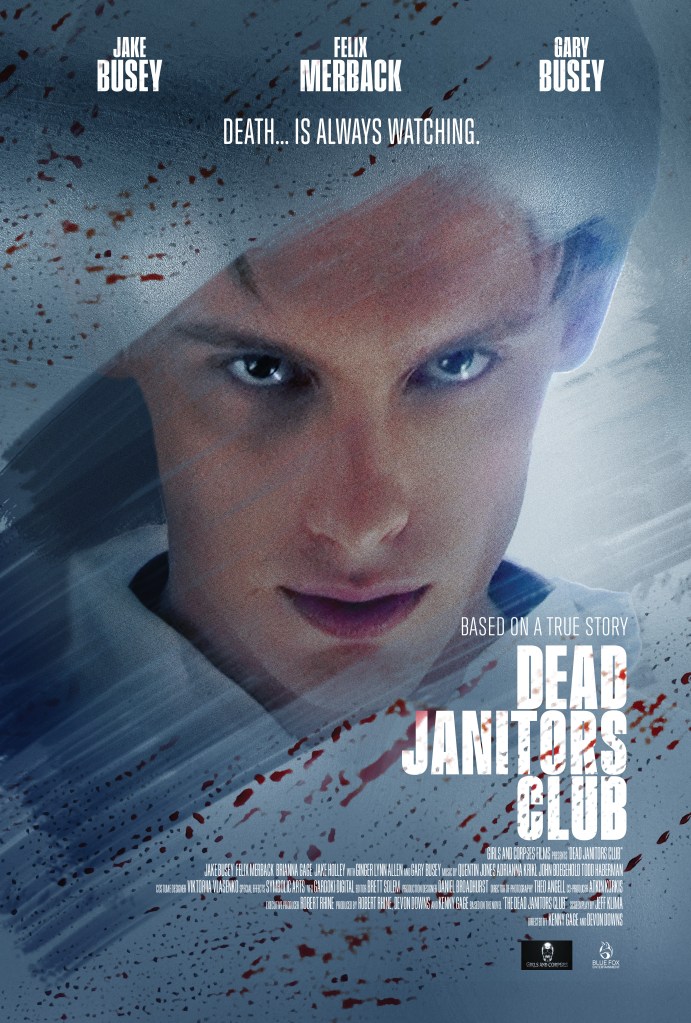
Dark comedy and crime rarely make comfortable companions, but the new film, ‘Dead Janitors Club,’ embraces their uneasy chemistry. The thriller brings an unusual and ambitious, but equally grounded, true-life story, to the screen.
Frequent genre collaborators, Kenny Gage and Devon Downs, helmed the movie. The duo also served as producers on the film with Robert Rhine. Gage and Downs reunited after they made their feature directorial debut on the 2015 horror mystery thriller, ‘Anarchy Parlor.’
Jeff Kilma wrote the script for ‘Dead Janitors Club,’ which he based the story on his 2010 memoir of the same name. The thriller stars Jake Busey, Felix Merback, Gary Busey, Brianna Gage and Jake Holly. The film is now playing in select theaters and on VOD, courtesy of Red Hound Entertainment.
‘The Dead Janitor’s Club’ follows Jeff (Merback) through an unexpected career. He becomes involved in crime-scene cleanup while navigating danger, relationships and circumstances beyond his experience.
Kenny Gage, Downs, Merback and Brianna Gage generously took the time recently to talk about helming, producing and starring in the movie during an exclusive interview over Zoom. Among other things, the filmmakers and actors discussed how they adapted Klema’s memoir into the movie, emphasizing collaboration with the author, authentic casting, natural performances, practical effects and real Los Angeles locations. They also highlighted their creative approach to cinematography, editing and an eclectic original score to capture the story’s dark humor, crime, romance and unpredictable true-story elements.
The journey of adapting the book into the movie began nearly three years ago, when Ryan approached Gage and Downs with the project. The producer had optioned Klema’s book and believed the directing duo could capture its unusual tone. The filmmakers read the screenplay that night and immediately connected with its real-life crime-scene-cleaning adventures.
Their enthusiasm launched a development process involving Klema and multiple screenplay revisions. Working directly with the author gave the helmers access to experiences that shaped the film’s emotional foundation. One murder story particularly affected Downs because Klema had preserved the original newspaper clipping for years. That event became an important turning point within ‘Dead Janitors Club.’
The directors also approached casting with an old-school independent-film mentality. Casting director Paul Ruddy emphasized in-person auditions rather than relying exclusively on taped performances. Merback completed chemistry reads with Gage and Jake Busey before the principal cast was finalized. That process helped establish the natural chemistry essential to ‘Dead Janitors Club.’
For Merback, playing Jeff offered an unusual opportunity to portray someone who actually lived these experiences. He connected with Jeff’s uncertainty, difficult circumstances, and determination to find direction. The role also appealed to the actor because ‘Dead Janitors Club’ combines darkness with humor in ways he personally appreciates.
Merback approached playing Jeff as the audience’s entry point into the unfamiliar world of crime-scene cleanup. Not knowing the industry’s procedures became useful rather than limiting. Jeff learns about the profession throughout the story, allowing the audience to discover its realities alongside him.
Gage found an equally personal connection with her character, Carrie. While the filmmakers changed certain details, Carrie’s emotional qualities remained important. Brianna responded to the character’s mysterious nature, compassion, toughness and willingness to help others. Her chemistry with Merback developed naturally, requiring little formal rehearsal before filming.
The production encouraged its actors to listen carefully and react authentically. Kenny and Devon welcomed creative ideas while maintaining the screenplay’s structure. Approximately 90 percent of the dialogue remained intact because the original writing already possessed distinctive rhythms.
Klema’s background as an author influenced the screenplay’s unusual dialogue patterns. His first screenplay did not follow conventional Hollywood dialogue beats. Instead, the conversations carried a distinctive rhythm that gave actors opportunities for spontaneity.
Merback drew from his theater background while embracing film’s unpredictable nature. He believed preparation created the freedom necessary for genuine reactions on camera. Working opposite Jake Busey further encouraged him to listen and respond rather than anticipate every moment.
‘Dead Janitors Club’ was filmed on location throughout Los Angeles, strengthening its independent filmmaking spirit. Local businesses opened their doors, providing authentic environments for several memorable sequences. The production even transformed a tattoo parlor into a bloody crime scene.
The filmmakers prioritized practical effects whenever possible, particularly for blood and physical action. Approximately 90 percent of the blood effects were created practically. The approach helped preserve the gritty, tactile quality envisioned for ‘Dead Janitors Club.’
The production also featured stunt coordination and a major tattoo-parlor sequence involving weapons and extensive practical effects. Despite the challenges, the filmmakers embraced the controlled chaos of practical filmmaking. Their goal was to make every location and physical moment feel immediate and believable.
Gage and Downs collaborated closely with cinematographer Teao Loha to create the thriller’s visual language. Their long working relationship allowed them to communicate quickly while pushing their creative ambitions. The team used shot lists, multiple cameras, and Steadicam work to make the independent production feel expansive.
Music became another major storytelling tool for ‘Dead Janitors Club.’ The production ultimately incorporated 82 original pieces, giving characters and locations distinct musical identities. Dirk’s scenes lean toward rockabilly, while Jeff’s darker moments enter electronic and synth-driven territory.
Other sequences explore punk, alternative rock, thriller textures and additional electronic sounds. Composers including Quinton Jones, Adriana Ciccone, John Begold and Todd Haberman contributed different musical approaches. The filmmakers wanted viewers to recognize characters and locations through sound before fully processing the visuals.
Editor Brett Schoon also played a crucial role in balancing those elements. His long-standing creative relationship with the directors provided an established shorthand during post-production. Together, the team shaped the final rhythm between performance, cinematography, sound, and music.
For the filmmakers and cast, ‘Dead Janitors Club’ represents more than another independent production. It reflects collaboration, creative risk, practical filmmaking and a commitment to an extraordinary true story. The movie’s unusual mixture of crime, comedy, darkness, romance and suspense gives it an unmistakable identity.
For Merback, the release also marks a significant career milestone. The comedy’s theatrical availability offers audiences an opportunity to experience ‘Dead Janitors Club’ collectively with other viewers. Its video-on-demand release further expands that experience for viewers watching from home.
Ultimately, ‘Dead Janitors Club’s story thrives on the same unpredictability that drives its characters. Its creators embraced real locations, spontaneous performances, practical effects and unconventional musical choices. The result is a darkly comic crime thriller built around an even stranger truth: sometimes reality creates the wildest stories.