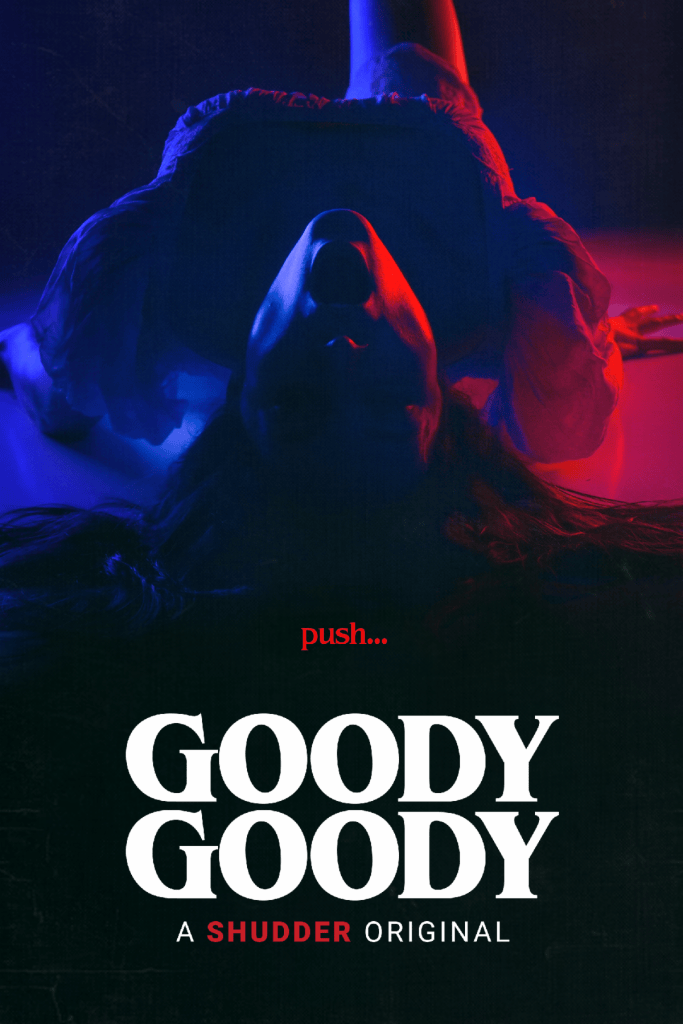
Horror often finds its greatest scares in the most intimate and familiar places. The new suspense film, ‘Goody Goody,’ turns one of life’s most profound experience – childbirth – into the foundation for a supernatural nightmare. The project follows a home birth that takes a terrifying turn, blending the claustrophobia of a single-location thriller with the dark history of witchcraft.
Raymond Creamer wrote and directed the movie. Samantha Robinson, Zoe Renee, Colby Hollman and Colleen Foy lead the movie’s small ensemble cast.
The begins streaming on Shudder today, September 18. The feature’s official release comes after it made its World Premiere at this year’s Overlook Film Festival. itt then went on to have its International Premiere at the Calgary Underground Film Festival.
In ‘Goody Goody,’ expecting parents and their midwife are lulled into a necessary sense of comfort during a long home birth. During the process, they begin to realize something may be horribly wrong. A blizzard rages outside, trapping the family in their home as increasingly sinister complications arise.
Creamer generously took the time recently to talk about scribing and helming ‘Goody Goody.’ Among other things, he discussed the real-life experiences and historical events that inspired the screenplay, the challenges of shooting in a single location, his collaboration with the cast and crew, and the experience of bringing the film to audiences through Shudder.
Film Factual (FF): You wrote the script for the new horror film, ‘Goody Goody.’ What was the inspiration in creating the story? What was the process like in developing the story and working on the screenplay?
Raymond Creamer (RC): Well, about 15 or 16 years ago, my cousin Aaron and his partner had a home birth. At a certain point in the evening, their midwife told them, “Hey, it’s probably nothing, but maybe we should just go to the hospital to be safe. There’s a bit of a yellow flag here.” Everything was fine. Mom and daughter are happy and healthy to this day.
I remember that being the starting point for the idea, when it first began to grow in my mind. But I didn’t really know what to do with it until I was reading about a witch trial from 1658. A woman’s child was wailing, and she was racked with fits and fever. She accused another woman in town, Elizabeth Garlic, or Goody Garlic as she was known, of having bewitched her.
There was a whole witch trial that almost accidentally ended with her being found innocent because they said, “We all know witchcraft is real, but she’s just a farmer’s wife. She couldn’t have possibly harnessed it.”
When I was reading about that, I think she was known as the Witch of East Hampton, Goody Garlic. That clicked with the home birth idea that was already germinating in my mind, and it felt like the two thoughts completed each other in a really natural way.
This notion of a home birth that goes wrong in the worst possible way, combined with a supernatural element, became the foundation of the film. After that, it was sort of addition through subtraction. I felt like, in the long history of pregnancy horror movies, there really wasn’t one that just focused on labor.
I wanted to zero in on that as much as possible. I wanted to try our best to carve our own lane in what can be a pretty well-worn subgenre.
Q: Besides penning the script, you also directed the suspense film. How did scribing the drama help influence the way you approached helming the movie?
RC: Writing and directing this film was the privilege of a lifetime. I love what I do. I think making movies is probably the greatest joy I’ve ever felt.
When it’s over, you do have a weird withdrawal where you’re just like, “I feel like I just got to live my dream for a month, and now it’s over.” Maybe if I’m lucky, two years from now, I’ll get another few weeks of joy.
It was phenomenal. The cast was incredible. Samantha Robinson and Zoe Renee, who play Goody and Candace respectively, were at the top of my list for their roles. I was so honored that they both said yes.
Colleen Foy and Colby Holman, who play Sarah and Jason respectively, auditioned for their parts, but they ran away with them. There was no question in my mind that they were right for the roles once they had locked in.
The four of them were so exquisitely talented and devoted to the film. They knew the script cover to cover. They could have performed it like a play.
On top of that, shooting in Minnesota in the dead of winter was so freeing for me. I’m out in California right now and it’s 100 degrees. I hate the heat, but I grew up in the Midwest. I love the snow. I love the cold. It felt like everything was coming together.
The cabin was beautiful, and the crew was incredible. Not only were they incredibly skilled at what they do, a lot of them were enthusiastic about being able to work on a feature. Most of the stuff that comes to their area is commercials, industrials, local TV or similar projects.
For example, we had a camera operator on this film, Kyle Johnson, who is super talented. His job is operating the camera at home games for the Minnesota Vikings.
It felt, in a weird way, like when you’re in Los Angeles shooting a project. People are great at their jobs, but it becomes somewhat routine. They show up to set, get the job done, and that’s it. We all know what it feels like to punch a clock. I’m no stranger to that.
But it felt like the folks in Minnesota all had something to prove. Whether it was us trying to make a scrappy, low-budget feature or them, as competent professionals, wanting to show what they could do on something more cinematic, everyone had a reason to give it their all. They could have some fun rather than just make their days and wait for lunch.
From start to finish, I can’t think of a single person, either in front of or behind the camera, that I would replace. They were all incredible, lovely people. After the first couple of days, everyone just started rowing in sync, and it felt like we were unstoppable. The wind is at your back.
FF: Speaking of filming ‘Goody Goody’ in Minnesota and using the home as the project’s main location, how did that setting influence the development of the story and the way you wanted to tell it?
RC: I knew early on in the scripting stage that, even before things became supernatural, we had to keep them in the house. It naturally lent itself to a snowstorm, and we were so lucky because Minnesota just got dumped on that year. There was so much snow we had it up to our ears.
The location itself was one in a million, but it was probably one in a few hundred because I think that’s how many cabins Keley Kemp, our line producer, and our unit production manager Devon Brahmy showed me online, just going through pictures on Airbnb, Vrbo and other sites.
Knowing what I wanted in my head, I had a checklist. We needed a big great room, and I really wanted that loft overlooking the room.
Looking at the pictures, I was trying to map everything together in my mind. Does this picture connect to this picture? If so, we probably have our dream cabin.
I went out to Minnesota to scout the location. They showed me probably 300 cabins, and I went to Minnesota just to look at one. We rented the place for a day so I could walk around, take measurements, take photos and videos, and really work out how the movie would fit in this container.
The only thing I would change about that cabin is that there are certain walls I wish I could move by a few inches here or there.
For example, very early in the film, there’s a dolly shot that goes all the way around the pool. We could lay down 270 degrees of dolly track because the track hit the windows on the far side behind the pool, and then it stopped at the counter and wall on the other side. If we had one more inch of space, we could have completed a 360-degree track run.
But I always think limitations help you access a new creative level. When we laid down those 270 degrees and situated the pool in the middle, it made me think, “If we need that extra bit of oomph, let’s put a small arm on the head and get the camera out just a little bit more so we can swing it around to the left at the end of the shot and try to complete that 360 degrees.”
Little things like that help you open your third eye and get into problem-solving mode. Directing is just a series of hurdles that you hope to jump without tripping.
Q: Did having those limitations also help when you were working with the actors to build the emotional and physical aspects of their characters?
RC: I think in a way, yes. All of them are consummate professionals, and we had so many conversations before leaving for Minnesota, except with Colleen.
I met Colleen literally the day before I left for Minnesota. We met once. She had a great audition, and then we had a meeting, which was sort of our callback. We immediately clicked.
She and Samantha hit it off really well at that meeting. Samantha told me as we were walking out of the café after meeting with Colleen, “I feel like it’s not just my midwife. I feel like I met my sister. I feel like she completes the trifecta between me, Zoe, and her.”
I think the actors came into this thing prepared because I do a lot of long takes, and we didn’t have a lot of time. I told them, “We’re going to be locked in. The more you know your characters and know this script, the better, safer, and more quickly we’ll be able to move.”
As I said before, they could have done this movie like a play. The limitations became a challenge for them, too. They would lock themselves in their green room downstairs in the basement and work the material over and over again.
They bonded in the process, eating lunch together, making inside jokes, and goofing around. There was stuff they would come upstairs laughing about, and I’d ask, “What’s going on?”
They’d say, “Well, Colby said this, and then Zoe said that.” I’d say, “Okay, let’s throw this page of the script away. You guys do that. Go in there and needle each other like brother and sister.”
There was a really lovely familial energy, especially among the cast. I think their love for each other was boundless by the end of the film.
I think that was, in some capacity, a result of that pressure cooker: We have to get this right. We cannot waste takes.
FF: ‘Goody Goody’ is now streaming as a Shudder. What was your experience releasing the drama on the streaming service, and working with them to promote and release the feature?
RC: They’re the best. I was in New York City because the folks from Shudder who met me there were helping me through the festival circuit. I said in my introduction to that screening that basically every time I step off a plane for a new festival, someone from Shudder meets me at some location. I’m like, “I just met the new best person I’ve ever met in my life.”
They’re all the nicest, most considerate people. They’re super nerdy about horror the same way that I am. We had so many great conversations.
I’m also learning about festivals in real time this year because this is the first movie I’ve finished where they’re their own kind of pressure cooker. You want to see movies, but you also have press obligations, meetings with the Shudder folks, parties, karaoke nights, and everything becomes so cramped that you start to feel like you’re going crazy.
But Danielle Freiberg, who’s the VP o Festivals and Publicity at Shudder and IFC, was always an incredible grounding presence. Every time I found her in a crowd, I felt like, “Oh my gosh, I’m safe. I’m protected. These people are always looking out for me.”
I know that goes the same for their other filmmakers because at the Overlook Film Festival, I met the filmmakers behind three or four other Shudder movies. It felt like not only are they great at handling the rollout for these films, they genuinely care about fostering an internal creative community.
They’re the loveliest people on earth, and I hope I get to make a dozen movies with them. This one was such a privilege. I just hope it’s not the last!