
Only a couple decades ago, the conventional wisdom used to be that in polite company one didn’t talk about two matters — religion and politics. There was too much chance of offending someone’s sensibilities, the thinking went, so it was best to avoid broaching these subjects, at least in any substantive manner. These days, however, in a divided and emotionally riven country where the ostensible leader of the free world is a developmentally-stunted man-child who’s force-cast everyone in the reality show that serves as ongoing evidence of the unwinnable war with his own gaping psychological needs, politics is everywhere — in every corporate capitulation, every shattered norm of decency, every enthusiastically platformed lie. It’s inescapable.
Against this backdrop, a movie like 2006’s complex Catch a Fire, which was made during an unpopular war in the Middle East and against the backdrop of much sociopolitical anger and tumult in the United States, merits fresh reconsideration. Directed by Phillip Noyce, the film tells the true story of a humble, apolitical man, wrongly accused of terrorism by governmental apparatchiks, who eventually feels pushed into the very sort of disobedience and armed uprising against the state of which he was initially accused. In its effectively dramatized allegory, it summons to mind a lyric from U2’s recent song “The Tears of Things” that evocatively mixes anger with empathy: “If you put a man into a cage, and rattle it enough/A man becomes the kind of rage that cannot be locked up.”
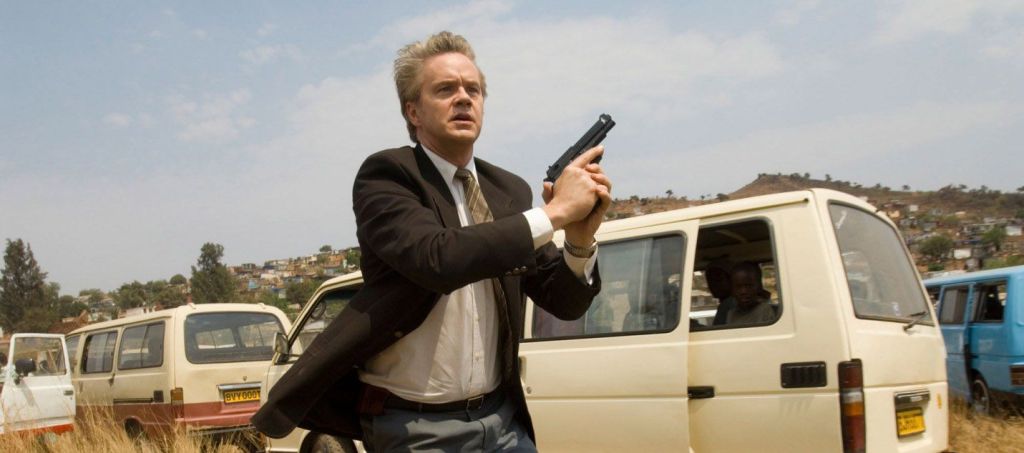
Set in apartheid-era South Africa, where for years 25 million native Africans were ruled and brutally oppressed by less than three million white colonial South Africans, Catch a Fire is based on the real-life story of Patrick Chamusso (Antwone Fisher’s Derek Luke). A simple family man and part-time soccer coach, Patrick serves as a foreman at the local oil refinery and loves his wife, Precious (Bonnie Henna), and two daughters, ages 8 and 6. An explosion at his plant, though, places Patrick and his friends under a cloud of suspicion, and he’s arrested by anti-terror unit chief Nic Vos (Tim Robbins), who’s tasked with rounding up the responsible members of the African National Congress, or ANC — an expatriate South African rebel group which operates out of neighboring Mozambique.
At first Nic’s questioning is cajoling, but he soon tacitly signs off on harder measures that certainly border on torture. Though innocent, Patrick has a secret that serves as a mitigating circumstance; when he finally tells the complete truth, Nic still views it as a ploy, and has Precious picked up and beaten by a government-sanctioned squad. Eventually freed but understandably shocked into action, Patrick finds his sense of self and purpose irrevocably reoriented. He leaves his family and sneaks across the border in order to become a political radical and rebel operative — fighting against the apartheid regime of South Africa for equality and the very future of his country.
The movie expounds upon and melds together some of the same themes touched upon in director Phillip Noyce’s austere 2002 two-fer of the Vietnam-set The Quiet American and the Australian-set Rabbit-Proof Fence. Each of those films are, in their own way, about the slippery slope of absolute authority and the warped decisions that it leads those in control to make in an effort to retain said power, and how government policy both official and coercive can have equally damnable, socially devastating consequences. Still, to call Catch a Fire a “political thriller” is a bit misleading. It’s much more a straight drama, with the particulars of its politics kept at a polite arms’ length. That said, while not driven by any sort of traditional action scenes, it does, as well, cultivate a certain amount of tension and dread as Patrick morphs into a political revolutionary and fitfully grapples with the notion of violence as an alluring form of expediency.
Catch a Fire comes to Blu-ray, from Kino Lorber, on a dual-layered disc with a fairly slim roster of supplemental extras. Three deleted scenes tally just over two minutes, and don’t provide much additional depth or characterization. One shows Robbins’ character excavating a piece of evidence at the site of the oil refinery blast, and another establishes the long hours and dedication of his job, featuring him getting called away from a family gathering. The final scene shows Precious receiving a piece of gifted furniture.
The film is presented in 2.35:1 anamorphic widescreen, which preserves the aspect ratio of its original theatrical presentation. The colors are sharp and consistent, and there are no issues whatsoever with grain. The movie was shot on location in Johannesburg, Cape Town and Mozambique, and cinematographer Ron Fortunato’s work is both searing and wide-ranging, capturing the jumbled sociopolitical backdrop that comprises Catch a Fire’s setting. Much use of natural light is made, and it’s remarkable, the variety of textures and moods that are conveyed — be it in the menacing blue-grey dusk of Nic’s outdoor water torture of Patrick, or the vibrant sunshine of a group of children’s dusty soccer match.
Lossless 2.0 and a 5.1 surround sound mix anchor Catch a Fire’s audio options, and each adequately captures the proceedings, with clear, consistent, discernible dialogue. The material itself doesn’t require a grand, wall-to-wall aural sweep, so the sound design places its emphasis on more restrained natural and atmospheric noises, all of which come through loud and clear. Rear channels, meanwhile, get a nice, subtle workout in the few sequences where violence or explosions spike. Especially notable is a slowly building scene where Patrick’s coworkers voice their support for the aims of the ANC through a buoyant group song as they’re patted down by white African security officers.
Apart from the aforementioned deleted scenes, the only other bonus feature is an audio commentary track that gathers director Noyce, stars Luke, Robbins and Henna, screenwriter Shawn Slovo, producer Robyn Slovo and the real-life Patrick Chamusso. These comments are frequently interesting, but don’t track with the action on the screen. Noyce talks about the movie’s use of the aforementioned freedom songs, advised by ex-ANC trainee David Embarta; he also fascinatingly discusses the war in nearby Angola and its relationship to South Africa’s struggle for independence, as well as how the movie relates to problems of reconciliation in his native Australia and elsewhere throughout the world (an element that lands as especially timely these days). Luke, meanwhile, talks about the difficulty inherent in preparing for his accent in the film, and bemusedly notes that Chamusso asked him, upon their first meeting, “Do you know Beyoncé?”
Bottom line: while a tide of rhetoric painting the world in broad strokes of black-and-white swirls around us, Catch a Fire invaluably reminds viewers that there are those who do “noble” service in the name of misguided or otherwise perverted callings, and that they aren’t blind to the contradictions and shortcomings of a given system, or otherwise shuttered off from inwardly channeled doubt. It’s a film about life’s grey areas — an involving drama, as well as a psalm and plea for a higher moral and ethical dialogue. For more information about the release and/or to purchase the Blu-ray, click here.

