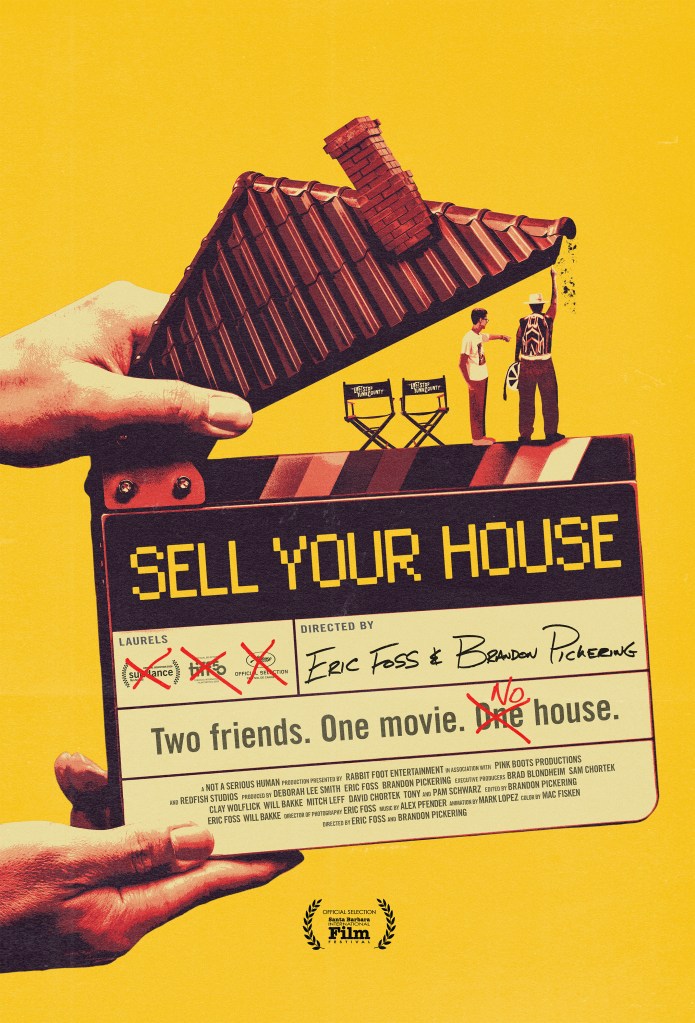
Independent filmmaking is often accompanied with unpredictable realities that can easily taunt any director. The new award-winning documentary, ‘Sell Your House,’ proves just that with humor and heart.
The upcoming documentary follows the making of the critically acclaimed action Western feature, ‘The Last Stop in Yuma County.’ The 2024 feature marks the helming debut of filmmaker Francis Galluppi, who’s currently writing and directing the anticipated prequel, ‘Evil Dead Wrath.’
Eric Foss and Brandon Pickering, who are friends with Galluppi, helmed ‘Sell Your House.’ The comedic documentary follows the filmmaking duo as they document the first-time director as he convinced his best friend to sell his house to finance their debut feature. The documentary turns the high–stakes gamble into a funny, revealing look at creative ambition and the challenges of independent film distribution.
‘Sell Your House’ had its world premiere at the Santa Barbara International Film Festival. It went on to screen at Film Invasion, Dances With Films and Sidewalk Film Festival. The movie will have its international premiere at Sitges Film Festival and DocsMX. The documentary will screen at Sitges tomorrow, Tuesday, October 13 at 12:40pm CEST at Cinema Escorxador in Barcelona, Spain.
In honor of ‘Sell Your House’s screening at Sitges, Foss and Pickering generously took the time earlier today to talk about helming the film during an exclusive interview over Zoom. Among other things, the filmmakers discussed
Film Factual (FF): You both served as the directors and producers of the new documentary, ‘Sell Your House.’ How did the initial idea for the film come about, and how did you approach making the project?
Eric Foss (EF): Francis and I had been friends for five or six years before he went into production on ‘The Last Stop in Yuma County.’ I was hanging out with him, and he was trying to get as many friends on set as possible.
He asked me what I wanted to do to help him out. I didn’t expect him to ask me, so I was taken aback. I told him I wasn’t a very good grip, but I was happy to help. I also told him that he should probably hire somebody who knew what they were doing.
I’d just done a little short documentary, so he suggested I come on set and shoot some behind-the-scenes footage. I agreed, and the project kept blossoming from there.
Eventually, I talked to Francis and James and pitched the idea of developing it into a feature documentary. Three and a half years later, here we are.
FF: Speaking of Francis, I interviewed him when ‘The Last Stop in Yuma County’ was initially playing on the film festival circuit in 2023. What was your experience working with him throughout production?
Brandon Pickering (BP): Francis has this magic power that makes everyone around him feel like his best buddy. He’s such a sweet dude.
I think the benefit of working with both Francis and James is that they love good movies. We were making a very personal documentary about their lives. So they understood that being extra honest would make our documentary better.
I’m forever grateful to both of them for letting us into their lives for so long and putting their struggles on screen.
FF: Once you started working together on ‘Sell Your House,’ how did you approach your directorial helming duties? What was the experience like as you began shooting the behind-the-scenes footage?
EF: It was a tricky balance initially because I was the only one filming the production process of ‘The Last Stop in Yuma County.’ Brandon came on a few months later, initially during post-production. He then started joining me more on set as we filmed the later scenes in the second half of the movie.
Everyone on set was there to make something else. They weren’t making a documentary; they were making ‘The Last Stop in Yuma County.’ It was tricky to navigate that environment without impacting their work. But I still had to get the story, ask the right interview questions and finding moments when I could ask questions without disrupting what they were doing.
BP: We quickly found a healthy working relationship. One of our first conversations was about treating the process like a writers’ room, where there are no bad ideas. All ideas are valid, and a bad idea could spark a good one, so you should just say it.
That became our mantra throughout the entire process. Let me tell you, we’re really good at coming up with bad ideas. We threw everything at the wall and tried everything. There was a cut of this movie that had RoboCop in it. We were just doing whatever.
Working with Eric has been amazing. It’s a collaboration that I think worked out surprisingly well.
FF: What was the experience of conducting interviews on set like? How did you figure out when to ask questions and what to ask during production?
EF: I’ll tell you a story. The first day of production went surprisingly well. They had a live bird at sunrise, and it did exactly what they wanted on the first take. Everything went really well.
Francis was nervous about directing Jim Cummings and Jocelin Donahue, but they were great. Everything went perfectly, so he was on a high and thought the next 20 days would go the same way.
But on day two, a storm hit. Desert storms are really violent, and this one ripped through the diner, knocked over some lights and shut down production for about an hour and a half. They couldn’t get a bunch of shots, and it was intense and troubling.
My job was now to get Francis to talk about how bad things were, how the storm would affect the production schedule, what he was going to do and how he was feeling. These aren’t questions you want to answer when things are going wrong.
He actually refused. He told me he didn’t have time because he needed to do his job, which was understandable. But I still needed that material.
After he left the set at the end of the day, I called him, and we had a back-and-forth and a little heart-to-heart. There was some tension, but he eventually agreed to an interview. I went over to his Airbnb, and we filled in the gaps.
It’s hard to do something as difficult as making a movie while also giving someone time to ask you about the things you don’t want to think about. You want to think about the good stuff, not the hard things you’ve just experienced.
I’m very good at showing up when someone’s incredibly stressed and asking them to explain everything that’s going wrong and why they’re failing. It’s good for our movie, but it’s hard to do in the moment.
FF: Eric, you also served as the director of photography on the documentary. How did you visually shoot ‘Sell Your House’ on set?
EF: My camera approach is what they call a single-camera follow documentary. It’s a style of shooting I learned while working on ‘Naked and Afraid’ for a long time. The idea is to make things as vérité as possible. You show up and shoot with one camera, capturing everything in a way that allows you to edit later.
It’s difficult because you’re essentially cutting the movie in your head as you shoot. I use a zoom lens because it allows me to react more quickly. You need a wide shot, a medium shot and a close-up for every subject and action, even though you don’t know what’s going to happen.
You’re reacting quickly and continually editing in your head, as if every moment will end up in the movie. That’s my approach.
It creates a raw feeling. The footage feels very real, but not necessarily polished. I try to polish it as much as possible while shooting, but sometimes you miss things. You can only do so much.
Later, you try to fill those gaps with B-roll, shots of the backs of people’s heads and other footage that gives you a cut point or helps the edit make sense.
Even when nothing is happening, I keep shooting because I’ve often been stuck in the editing room wishing I had footage that simply didn’t exist. I assume I’ll miss something later, so I capture time-lapses, exteriors, close-ups, and little details around the diner, just in case I need them.