
Part of the reason celebrities occupy a monarchical stratosphere in the United States (and perhaps why we elected as president a real estate blowhard and onetime reality show host with no readily discernible positive qualities), is that we seem, as a society, addicted not only to the traditional narrative cycles of debutante presentation, evolution, destruction and reinvention, but also the polarities that the rich and famous live out — lifestyles of wild excess which, by definition, cannot be sustained.
Rock ’n’ rollers probably most embody this behavior. But one of the few modern traditional artists who seemed, on an almost instinctive level, to grasp the peculiarities of this public appetite was Jean-Michel Basquiat, a painter who rocketed from graffiti-tagging anonymity and bohemian near-homelessness to avant-garde superstar status.
Born in December 1960 in the Park Slope neighborhood of Brooklyn, the second of four children to a Haitian-born accountant father and Puerto Rican mother, Basquiat had a distinctly middle-class yet nonetheless turbulent childhood — he was hit by a car at age seven, and his mom was admitted to a psychiatric hospital when he was 10 and thereafter spent the rest of his life in and out of institutions.
Basquiat would achieve notoriety in the late 1970s, after covering swaths of New York City with abstract poetic graffiti verses, tagged with SAMO (a quasi-acronym standing for “Same Old Shit”). A buzz built, and in 1981 he put paint to canvas for the first time, forming the “Downtown ’81” collective with some friends. In under a year he had his first formal show, for which he took home over $200,000 in a single night. Friendship and collaboration with Andy Warhol ensued, and he would become one of the youngest artists to exhibit at the Whitney Biennial, at only 22. Sadly, Basquiat would be dead at 27, felled by a heroin overdose.
The debut film of painter turned writer-director Julian Schnabel (he would go on to make The Diving Bell and the Butterfly and At Eternity’s Gate, among others) lives in a lot of the so-called spaces in between in this chaotic life. It’s much less a conventional snuffed-too-young biopic, and more of an impressionistic, elegiac rumination on art and celebrity, funneled through one subject.
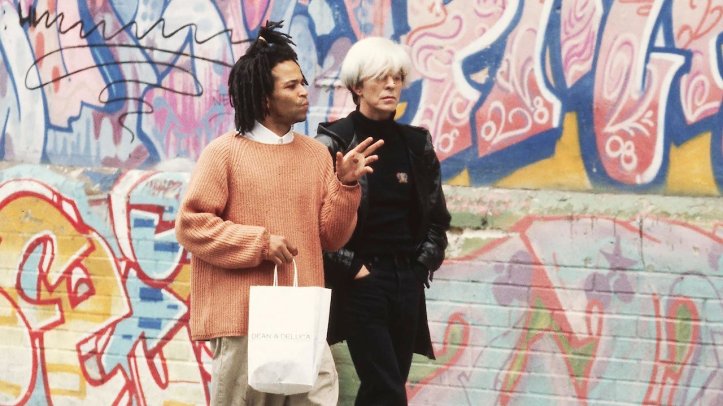
Opening in the late 1970s, the movie finds Basquiat (Jeffrey Wright, in a star-making turn after winning a Tony Award for stage performance in Angels in America) existing on society’s fringes — sleeping in a cardboard box in Tompkins Square, and spending his days with friend Benny Dalmau (Benicio Del Toro). We see a skewed meet-cute with waitress Gina Cardinale (Claire Forlani), herself an aspiring artist, wherein Basquiat pours pancake syrup on his table and sketches a portrait of her; in short order, he seals the deal, and the two are living together. One day Basquiat witnesses the already-famous Andy Warhol (David Bowie) enter an eatery with art dealer Bruno Bischofberger (Dennis Hopper). Boldly following them inside, he pitches them on his own avant-garde postcard art, and makes a bulk sale. Others take note too, and soon Basquiat has the rapt attention of various tastemakers; pitched by one dealer as the “true voice of the gutter,” Basquiat takes off.
While certain key real-life individuals, like ArtForum writer Rene Richard (Michael Wincott) and collector and dealer Mary Boone (Parker Posey), are featured in the movie, many other figures in Basquiat’s life are presented here as composite characters. A hearty roster of recognizable faces, from Courtney Love to Sam Rockwell, fills out this parade of cameos; the character of Albert Milo (Gary Oldman), meanwhile, serves as a stand-in for Schnabel himself — a way to examine his own relationship and role as a witness to Basquiat’s meteoric rise. (Schnabel’s young daughter Stella also cameos as Milo’s daughter in an extended sequence, after Milo has made peace with his role in Basquiat’s shadow and attempts to counsel Basquiat on his own relationship with Warhol.)
Given his own background as a fine artist, Schnabel has a sharp sense of how artists are at the mercy of recognition, and a benefactor system where one’s appearance and public-facing persona matters almost as much as one’s skill or vision. (“I’m glad I never got any recognition, it gave me time to develop,” says a sculptor, portrayed by Willem Dafoe, who daylights as an electrician.) Schnabel threads the knowledge of this lived experience throughout his movie (more on this a bit later), even if only lightly. He also trades heavily in mood (music selections play a key role in this, from a cover of “It’s All Over Now, Baby Blue” by Them, to needle drops of the Rolling Stones’ “Beast of Burden” and Grandmaster Flash Melle Mel’s ubiquitous “White Lines,” among many others), and doesn’t get bogged down in specific dates while conveying the passage of time.
Symbolic and impressionistic imagery is seeded throughout the movie, in artful fashion. The opening credits show Basquiat as a boy in the art museum, his mother gifting him a glowing crown which he places on his head; later viewers are given glimpses of how Basquiat sees the world, with Schnabel showing interpolated surfers riding waves over the tops of buildings.
What gives Basquiat its strong hold, however, is undeniably its wonderful performances — Wright mesmerizingly conveys a rich and uncertain inner life, through the tilt of his head and pose of his hands — as well as a strong sense of its character dynamics and relationships. It’s true that the movie doesn’t necessarily dig into its subject’s feelings about pronounced ambition (said to be well known), and his penchant for the knowing presentation of self. Perhaps the closest the film comes to this is a scene with an interviewer (Christopher Walken) who attempts to tease artistic explanation out of Basquiat, only to have him finally allow that, perhaps, his self-image, dreadlocks and all, is something that contributes to his success, amongst a upper-class demographic that skews overwhelmingly white.
If this side of the artist—someone confused and overwhelmed and perhaps not formally educated, but also very intelligent, shrewdly calculating, and possessing both a keen awareness of and heavy investment in the material benefits of personal mythology—is perhaps a higher degree of difficulty, it’s also undeniably more interesting than some of the scenes the movie serves up. The forgiving reading of this shortcoming is that it jibes less with Schnabel’s subjective view of Basquiat, and thus doesn’t comfortably fit within his telling. In the end, it’s no huge dealbreaker, as Wright’s superb turn and all of the other fine acting work make this an easy and engaging watch, even if not quite on par with Schnabel’s later work.
Basquiat comes to Blu-ray via Criterion, and with one big notable change from its original 1996 theatrical release under Miramax Films — a black-and-white presentation (which Schnabel wished to affect), in a 4k digital restoration, with a 5.1 surround DTS-HD master audio soundtrack. While I miss the colors that, in my view, help give it a grungy, mid-’90s NYC aesthetic, and thus prefer that version, there’s no denying that the artfulness of the film’s compositions translates to black-and-white.
Bonus features are anchored by a moderated audio commentary track between Schnabel and writer/curator Giulia D’Agnolo Vallan, and it rather immediately becomes clear that Schnabel, a fine interview in real-life if one is both curious and prepared, might not have felt keen to do the heavy lifting of a monologue-type overview. This “two-hander” approach, while not without some small hiccups, does really take flight when Schnabel gets into more and more details about both his connection to Basquiat and the New York City art scene of the era.
A 55-minute interview with Schnabel and Bowie from a 1996 episode of The Charlie Rose Show is a welcome trip down memory lane, with the director talking about his inspiration for making the movie and Bowie praising the aforementioned scene between Walken and Wright, among other bon mots. A new 25-minute interview with the erudite Wright is the real gem — he’s candid about just how out of his depth he felt in making the transition from stage to screen. A thoughtful essay from film scholar and Santa Barbara International Film Festival Executive Director Roger Durling rounds things out.

