
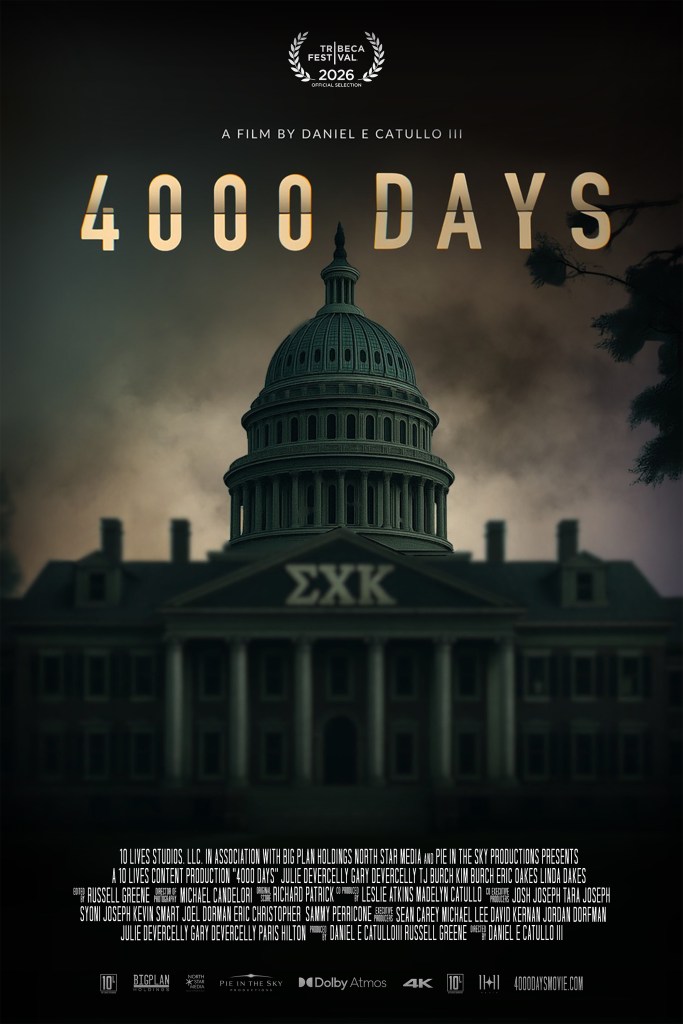
In an era when accountability is often elusive, the new documentary ‘4000 Days’ explores the extraordinary resilience of families who transformed unimaginable loss into a movement for change. Centering on the aftermath of hazing-related tragedies, the film examines grief as a catalyst for action. Through parents’ pursuit of justice and reform for their children, the movie is a powerful meditation on perseverance and collective advocacy. Most importantly, the feature highlights the enduring impact ordinary people can have when they challenge entrenched systems.
Emmy Award-winning filmmaker Daniel E Catullo III wrote, directed and produced the feature. The biographical movie features the experiences of the Burch, Oakes and DeVercelly families, whose lives were forever altered by hazing-related tragedies and the activism that followed. Through, the film examines both the devastating human cost of hazing and the ongoing effort to make college campuses safer.
‘4000 Days’ chronicles how the three families began a relentless public fight for change after losing their sons to fraternity hazing. They decide to turn their personal tragedies into a movement. Refusing to accept that their children died in vain, they join together in waging a multi-year battle to expose an entrenched system mired in denial and secrecy, challenging both the fraternities and universities to be held accountable.
The movie, whose title representing the number of days it took to turn grief into action and law, captures the family’s journeys. From intimate personal moments to painful court appearances, the documentary tells a story not just about loss, but also one of resilience, undying determination and the power of ordinary people to turn tragedy into lasting impact.
‘4000 Days’ will have its World Premiere in the Spotlight Documentary section of this year’s Tribeca Festival. The film’s premiere screening will be held this Wednesday, June 10 at 5:30pm ET at the Village East by Angelika theater in New York City. To help promote the movie, Catullo generously took the time recently to talk about scribing, helming and producing the project.
Film Factual (FF): You wrote the new documentary, ‘4000 Days,’ with Russell Greene. What interested you in making the film, and how did you shape the story for the feature?
Daniel E. Catullo (DEC): I make music for a living. I make live concert films and documentaries, so this is obviously the exact opposite of that.
I became involved in this film because I went to West Virginia University (WVU) and worked with the school on a lot of projects. In 2014, a student named Nolan Burch died in a fraternity hazing incident at Kappa Sigma. I knew what had happened, but I wasn’t fully aware of everything surrounding it.
A couple of years after Nolan died, Dateline did a special on hazing and highlighted the case. They interviewed Gordon Gee, the president of WVU, who is a friend of mine. The story really hit me.
I called Gordon the day after it aired and asked, “How can I help?” He said, “Dan, we have such a problem here. You have to help us.”
About two weeks later, I was in West Virginia meeting with him, the provost and the university’s attorneys. I came up with the idea of making an educational film about what happened. I told the university, “You should put this out there. Own up to it. Acknowledge that fraternity organizations are out of control and that the culture needs to change.”
We made a short educational film, and it ended up going viral. Suddenly, I was appearing on television and speaking at universities. Then other parents started reaching out to me, saying, “The same thing happened to my son, and it’s been covered up.”
I started going down this rabbit hole. In between working with artists like Katy Perry and Alicia Keys, I was making hazing films. Those educational projects grew into a larger idea, and I began developing a six-part series.
While working on that series, I noticed a story that reminded me of a film I had seen at Sundance called ‘Newtown.’ That documentary is about Sandy Hook parents coming together to take on the gun lobby.
I saw a similar story here, so I called Russell Greene, who edited ‘Newtown.’ He agreed to serve as my editor and producer on this project.
I saw a powerful story about parents banding together to challenge a system that I felt needed to be explored in a film. There were roughly two dozen families involved in getting a bill passed. I focused on three of them. What struck me was that they came from different backgrounds and held different beliefs, but they put those differences aside for a common goal: transparency.
I started following them and filming their journey. I didn’t realize how long the process would take because we had to wait for the outcome of the legislation.
I’m glad it ended the way it did. I truly believe these families are heroes, and I wanted the world to see what they accomplished.
FF: When you started making the movie, what additional research did you do to better understand hazing and its history?
DEC: When I first began working on the project, I was focused on the evolution of hazing. I was fortunate to work with organizations including the Clery Center, StopHazing.org and the Love Like Adam Foundation. I also consulted experts such as Dr. Elizabeth Allan.
At the same time, we conducted extensive independent research. We spent thousands of hours trying to understand the root causes of hazing because I genuinely thought there might be a way to fix the system.
That research led me to neurologists, psychologists, psychiatrists and other brain experts. In my upcoming six-part series, we explore whether 18- and 19-year-old young men are even fully equipped to make good decisions under intense pressure, given that the brain is still developing.
I’ve visited places like the Mayo Clinic and spoken with doctors to understand whether there’s a scientific explanation for these behaviors.
There are also modern influences that didn’t exist when I was in a fraternity in 1990. We didn’t have social media, and society feels more polarized today.
When you combine social pressure, ideas about masculinity, social media, alcohol and drugs, you create a recipe for disaster. Hazing is no longer about doing push-ups or cleaning someone’s room. Now we’re seeing incidents involving fire, dangerous amounts of alcohol, and severe physical harm.
Some of the things students are doing to one another today are difficult to comprehend. There aren’t enough people stepping in to stop it.
FF: Besides scribing the documentary, you also served as the director. How did you approach helming the film?
DEC: This was a difficult process because I had never directed a feature documentary like this before. My background is in music, where the goal is often entertainment.
Here, my goal was to connect with people emotionally. Fortunately, I had an amazing producer and editor who helped guide me through the process.
It was also challenging because I became very close to these families. When you’re emotionally invested in the people you’re filming, it can be harder to tell the story objectively. Thankfully, I had a strong team around me to help keep me grounded.
I maintained constant communication with the families, often speaking with them every day. As I got to know them better, it became easier to understand what they were experiencing and to portray that honestly in the film.
The hardest part was sorting through hundreds of hours of footage and reducing it to a 90-minute film. Our first cut was about three and a half hours long.
There were scenes I hated cutting, but you have to make difficult decisions and do what’s best for the film. These families had been living through these experiences for more than a decade, and we had to find a way to tell that story in a limited amount of time.
As I got to know them better, it became easier to recognize when an edit felt authentic and when it didn’t. If something didn’t accurately reflect who they were or what they were feeling, I knew it immediately.
The emotional weight of the subject matter was the biggest challenge. Most of my previous work had been upbeat and celebratory. This was very different.
FF: How did you approach building relationships with the families and selecting interview participants?
DEC: We interviewed more than 100 people, and unfortunately not everyone could be included in the final film.
The interviews were often difficult because you are asking people to revisit the worst moments of their lives.
The interviews that affected me most were with siblings. They are often the forgotten victims in these situations.
For example, Nolan Burch’s sister, Alex, gave a powerful interview that ultimately didn’t make it into this film. Hearing from brothers and sisters who lost someone they loved was incredibly moving.
One person who stood out was Gary’s younger brother, Noah DeVercelly. Gary was his hero. Noah told me, “I didn’t just lose my hero that day. I also lost my parents.”
What Noah meant was that when parents lose a child, they are never the same. Families never fully recover from that kind of loss.
As Gary says in the film, the days get a little lighter. You learn how to live with the pain, but the pain never goes away.
Those interviews were the hardest because you could feel the grief in the room. I remember my first interview with Linda Oakes. We nearly stopped because she struggled to get through it.
You leave wondering whether you’ve just forced someone to relive the worst day of their life. But if you’re going to tell the story honestly, those conversations have to happen.
FFF:‘4000 Days’ is having its World Premiere in the Spotlight Documentary section of this year’s Tribeca Festival. what does it mean to you that the movie is play at the New York-based festival?
DEC: I’m incredibly excited. When we found out we had been accepted to Tribeca, I cried. My agent kept calling me while I was on a plane. I couldn’t answer, so I kept sending him to voicemail.
When I finally called him back, he said, “You’re in.” I asked, “What do you mean we’re in?”
The craziest part was that I was meeting Julie and Gary DeVercelly in Las Vegas that night for Julie’s birthday. I happened to have a Tribeca sweatshirt with me. I wrapped it up and gave it to Julie as a gift. It became this wonderful moment because she couldn’t believe it.
More than anything, I wanted the world to see what these parents accomplished. Now, because of Tribeca’s platform, people will have the opportunity to see what these families did. They’re heroes.

