Finding one’s place in a world that no longer seems to recognize them is a powerful motivator for protagonists in nostalgic stories. That’s certainly the case for Harry Lehman, the titular character of the new drama, ‘The Only Living Pickpocket in New York.’
Exploring how aging and the passage of time affect people from all backgrounds, Harry’s story serves as a love letter to classic New York. Blending an intimate character study with the tension of a gripping crime thriller story, the film captures the enduring spirit of a city that is constantly changing.
Noah Segan wrote and helmed ‘The Only Living Pickpocket in New York.’ Rian Johnson, who directed Segan in all seven of his feature films, including ‘Star Wars: The Last Jedi’ and the ‘Knives Out’ trilogy, served as an executive producer on the new movie alongside Ram Bergman and Johnny Holland. The new drama stars John Turturro, Giancarlo Esposito, Will Price, Tatiana Maslany and Steve Buscemi.
‘The Only Living Pickpocket in New York’ follows Harry (Turturro), an old-school hustler. A classic native of the eponymous city, he moves through life paying people off with cash, and relying on his wits and connections. But times are changing for Harry. His daily pickpocket take isn’t green bills and wristwatches; it’s credit cards and cell phones.
On one particularly unfortunate night, Harry encounters cryptocurrency stored on a mysterious flash drive, a reminder of his struggle to navigate today’s digitally networked world. But he’s an opportunist, and decides to try to use the flash drive to his advantage. However, the decisions he makes that fateful day set in motion a series of events that transform his life forever.
‘The Only Living Pickpocket in New York’ had its world premiere at this year’s Sundance Film Festival in January. The feature then went on to screen at several other festivals across North America, including the Telluride Film Festival, the Toronto International Film Festival and the New York Film Festival.
Sony Pictures Classics will distribute the drama in a limited theatrical release in Los Angeles and New York City today, Friday, October 23. The movie will then expand to theaters nationwide next Friday, October 30.
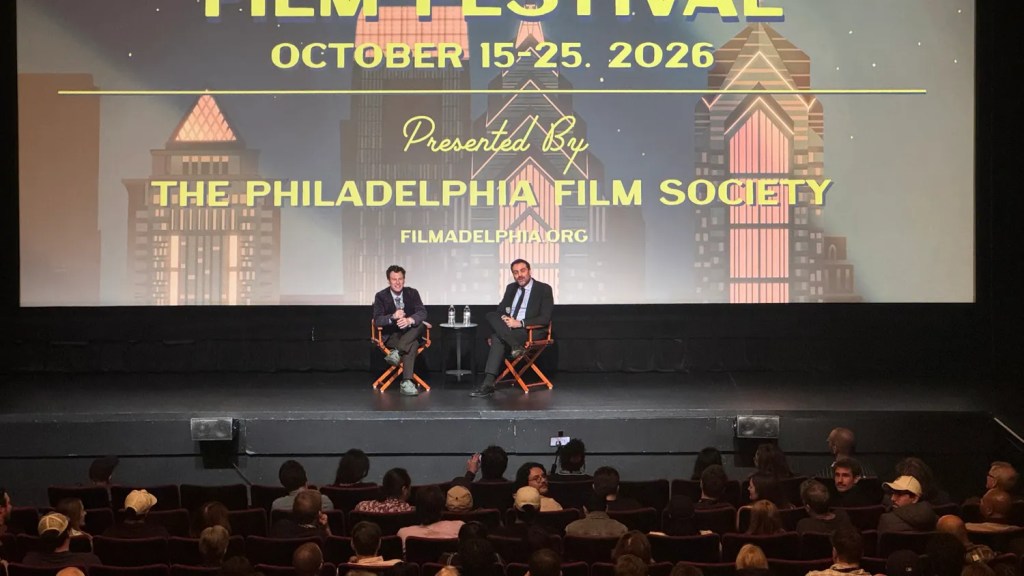
Segan discussed making ‘The Only Living Pickpocket in New York,’ during the post-screening Q&A at this month’s 35th Philadelphia Film Festival. The feature served as the festival’s Opening Night movie last Thursday, October 15 at the Film Society Center. The Q&A was moderated by the festival’s artistic director and senior director of programming, Michael Lehrman.
Watch the post-screening Q&A for ‘The Only Living Pickpocket in New York’ between Segan and Lehrman at the Philadelphia Film Festival in the video above, and listen to the discussion in the clip below.
Question (Q): The film is very much about somebody who’s aging out of being aware of new technology, among other things. It’s also very classic in its sensibility. Is there a part of you that looks around at the world and feels like you don’t understand what’s going on?
Noah Segan (NS): I’m a very analog guy. I like vinyl records and tactile things, so I romanticize that world a little bit. Of course, I live in a world where I have a cellphone and email people, too.
Q: You’ve mentioned that you shot across all five boroughs to make this movie. Were there any favorite New York movies you drew on for inspiration?
NS: It’s impossible not to think of Abel Ferrara, Sidney Lumet and filmmakers like that. You can think of them as an idea rather than a single movie.
Specifically, I was looking at ‘Small Time Crooks’ and ‘The Warriors.’ ‘Desperately Seeking Susan was a big inspiration, too, which has a great performance by Madonna and Rosanna Arquette.
Q: Did you have the music and costumes in mind as you were writing the film?
NS: I had some songs in mind. I put the song that John dances to on a playlist for him so he could vibe with it. He called me up and said, “Man, I haven’t heard that track since I was dancing to it in a disco 45 years ago.”
He really got into the song. One weekend, I received the best backtesting I’ve ever received in my life: a video John took of himself dancing to the song in his house. I thought, “You’re just filming yourself dancing?” We decided we had to put that in the movie.
As far as the score goes, Gary Lionelli is an incredible composer. I was a fan of his work. I researched him, and found out he’d done a wonderful Gordon Parks documentary. He had done a riff on Gordon Parks as a kid with The Black Panthers. I thought, if we can get a little bit of that, let’s do it.
Q: Spoiler alert: The ending features Harry kissing his wife on the head. Was that in the script, or did it emerge during editing?
NS: That was entirely an editorial discovery, and we were so lucky to find it. We obviously had the shot, but for a long time, he just walked out, and then we lost him as the camera panned away. I felt it wasn’t giving as much insight as I wanted. I wanted to give him his dignity and stay with him.
Hilda Rasula, our editor, came up with the idea of cutting away while keeping the live sound. We experimented with what to cut away to at the end. Rian (Johnson), our producer and a close friend I’ve worked with for many years, suggested looking at some of the moments with his wife.
We started trying different variations with Harry and Rosie, incorporating the sound from Milan. It all came together that way, so it was a real team effort.
Q: What is it like directing actors of this caliber, especially when you’re only making your second feature? Did you collaborate with them, or are you more directive?
NS: I’ve been lucky to have a lot of on-set experience as an actor. That’s one of the hardest things to get because shooting on set is the most finite part of the experience. I’ve also been fortunate to become friends with a lot of great actors who are good people and do good work.
There was a funny moment on the first or second day working with Giancarlo Esposito. He was a few feet away, and I called cut and started walking toward him. He’s a very nice, sweet guy, although he has a reputation for playing intense characters.
He said, “Noah, you yelled cut. Then I watched you walk toward me, and I could tell you were thinking about how to give me directions.” I said, “Yes.” He replied, “I appreciate that.” Then he laughed.
Honestly, all these people are not only great actors but great filmmakers, too. John (Turturro) and Steve (Buscemi) have made incredible movies they’ve written and directed themselves. Everyone understood the different aspects of filmmaking beyond their own roles, so it was a real collaboration. That took a lot of pressure off.
Q: Were there specific New York neighborhoods or locations you wanted to make sure appeared in the film?
NS: We shot on the block I grew up on. That’s really cool. We filmed on 26th Street, and it wasn’t as though we were shoehorning anything in. We were lucky that the locations we found happened to be just what we needed, and they were on the block where I grew up.
When you’re a New Yorker surrounded by other New Yorkers, you realize something has happened on every block. Everybody has a story: “I lived here,” “My grandma lived here,” “I got mugged on this corner,” “I had my first kiss on this corner,” or “I went to school around the corner.”
That was very much true for this movie. It was pretty cool to shoot near my childhood.
Q: Which scene was your favorite to write? How did you try to capture the feeling of New York in the screenwriting process?
NS: My favorite scenario might be the scene between Harry and his daughter Kelly. When you think about your own kids, it’s easy to imagine exactly what you’d never want them to say to you, or the exact opposite of the relationship you want to have. That’s scary, but when you’re writing in an office, it’s not scary because you can entertain the spookiest parts of yourself.
I don’t know if I’d call it my favorite scene in the film. But it was the most interesting part of the writing process.
I didn’t write a lot of New York into the script. I wrote the boroughs, but nothing too specific. I didn’t write B&H Dairy, the iconic diner where Harry eats. In my mind’s eye, it would have been one of the five diners like that I used to go to, and it turned out to be B&H.
Q: The film’s visual style is gorgeous. Did you shoot on film or digitally, and what was your approach to creating that look?
NS: The movie is representative of itself in that it’s very much a split between old and new. We shot on the Alexa, a traditional digital camera. But we used lenses made by Baltar, which were made famous by films like ‘The Godfather.’
They’re 50- or 60-year-old lenses that, in our case, hadn’t been terribly cleaned up. We left them as they were, with a little detuning.
We also used some lenses that belonged to our cinematographer Sam Rooney’s mentor, Harrison, who owned Baltars. It was really special to use his lenses.
Sam then built what’s called a lookup table to create a color palette he felt was most appropriate. We added some grain and other elements to give the film a more traditional, cinematic texture.